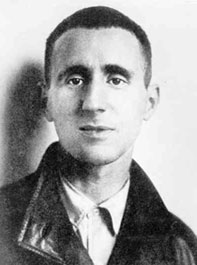
Brecht wrote this play in only THREE WEEKS, whilst in Finland, awaiting a visa for entry to the USA.
This play is heavily influenced by Hilter, and is seen as a satire of Hilters rise, and depicts the society at that time, and how it changed everything about society. The play was not available in English until 1961. The play is in the style of Epic Theatre, which was Brecht's main focus in plays.
The play included a prologue, which outlines the plots, scenarios and characters right from the beginning, so the audience KNOW exactly what is going to happen and they cannot change this.
Brecht was a firm believer in demonstrating, and not letting the actors be absorbed into their characters. He did not want the audience to feel the performance was real, this was not his aim. His aim was to make an impact on the audience and make them see what society is like and how they should make a change. He did not care for Naturalism, he was completely against Stanislavski, and felt audiences should not feel acting is real, he felt acting should portray the issues and outline how society changes everything. His plays are very political, but I argue that even though his plays are about real life situations, they are somehow not very realist, as he goes against Naturalism, and everything is very big and dramatic. Whereas Stanislavski felt actors should be very realistic and emotional, and wanted everything to be as believable as possible, as I feel he cared more about what the audience thought about the actors and the story lines of his plays, whereas Brecht, cared more about the real issues of his plays and the way the audiences felt AFTER watching the show.
Brecht was a firm believer in Karl Max and saw himself as a Marxist.
Marx was a German philosopher and believed that society issues were the root of everything and he was the founder of "Sociology" as he urged people to look into society and status. He felt that human societies progressed through class struggle, the constant battle between the wealthy who provide the money, and the working class, who provide the work! Coming from a wealthy middle class family, I feel Marx was very honest with his theories and wanted to make a change, as did Brecht, which is why the two went hand in hand. Marx wanted the working class to have equality, and wanted a classless society, Communism.
 |
| This quiote adds to how Brecht wanted to make his audience think, and he wanted to make a change in society. |
EXERCISE FROM TODAY:
"Gest"
This exercise explores the gestures and attitudes used when acting as a Stereotype. Which is what Arturo Ui is influenced by, as the play includes stereotypes. The exercise focuses on;
- Political Criticism of characters
- Finding movements
- Simplify & clarify the movements to create a stereotype of a certain person
- Gest
We were given 5 stereotypes and were asked to walk around the room, "gesting" as this stereotype.
- Polictian
- Dodgy car salesman
- Business man
- Call centre worker
- Defence barrister for a GUILTY murderer
All these stereotypes were portrayed in two different ways. We were either mocking the stereotype or being fair to the stereotype. For example, we were put into groups of 4, and I was with Max, Liam and Zac. We chose Politicians, and we decided to use contrasting gests, in which all four of us would walk around the space and appear to be very greedy, smug and two faced, glaring out at the audience and making faces behind each others backs. Another gest we used is shaking hands. Every time we caught each others eyes, we would shake hands and smile pleasantly at each other, and look out to the audience as if we were posing for a picture, and as soon as we let go of each others hands we would return to our smug and two faced stereotype, only shaking hands in order to appear genuine and nice, when really we were just acting as money grabbing politicians, we were not FAIR to the stereotype and that is how we saw ourselves. Whereas another group, were more fair, using genuine and open gests, which portrayed honesty and care, contrasting with ours as we were portraying greed and hate.
This exercise was interesting as we explored how different gests can create a different story to the audience, even when given stereotypical characters to play.

No comments:
Post a Comment